Estée Lauder partners with University of Leeds to advance complexion shade matching
While specific timelines and product roll‑outs have not been disclosed, the research is expected to inform future formula development and product testing protocols in the prestige cosmetics segment.

UK – The Estée Lauder Companies has collaborated with the University of Leeds and Dr Kaida Xiao, a globally recognised authority in colour science and visual perception, to tackle one of the beauty industry’s most persistent challenges: accurately matching foundation and concealer shades to the full, diverse spectrum of global skin tones.
The partnership brings together Estée Lauder’s R&D capabilities with the University of Leeds’ expertise in colour and imaging science to develop more precise, natural‑looking complexion products across the company’s luxury and prestige portfolio.
The initiative is framed as a step toward establishing new scientific benchmarks for evaluating foundation, concealer and related complexion‑enhancing products, with the goal of reducing shade mismatches and improving real‑world performance.
The project is led by Dr Kaida Xiao, Professor of Colour and Imaging Science at the Leeds Institute of Textiles and Colour (LITAC) within the University of Leeds’ School of Design.
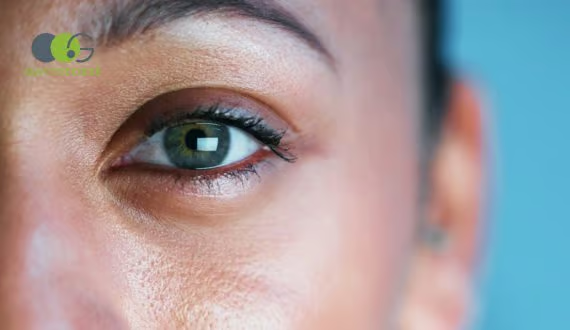
It employs advanced psychophysical methods, techniques rooted in visual perception science that study how people see and notice differences, to investigate how consumers perceive colour undertones and detect subtle variations in skin colour.
A central focus is the relationship between instrument‑measured colour data and human visual perception under everyday viewing conditions.
By mapping when small tonal differences become noticeable (or go unnoticed) to users, the research aims to refine how complexion products are formulated, tested and evaluated, ultimately enabling more accurate shade matching and more natural‑looking results on diverse skin tones.
For Estée Lauder, the collaboration addresses a long‑standing consumer pain point: despite advances in beauty technology, many shoppers still struggle to find foundation and concealer shades that truly match their skin.
The company says the insights from this work will help improve shade accuracy, support the development of higher‑performing formulas that appear more consistent on skin, and drive continued innovation across its prestige brands.
The partnership also underscores Estée Lauder’s broader push into colour science and data‑driven shade matching, building on earlier initiatives such as its Colour Capture technology, which uses spectrophotometer measurements and algorithms to recommend foundation shades from extensive ranges.
By integrating deeper perception research with existing measurement tools, the company aims to move beyond purely instrumental colour metrics toward systems that better reflect how consumers actually experience shade matches in daily life.
Sign up to receive our email newsletters with the latest news updates and insights from Africa and the World HERE.