
BASF introduces paper binders with 45% lower carbon footprint
BASF introduces paper binders with 45% lower carbon footprint
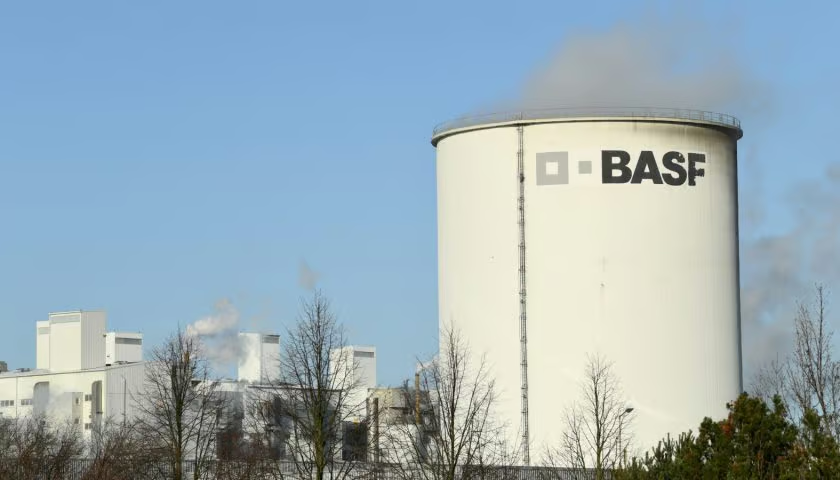
GERMANY – BASF is rolling out a new range of dispersions for paper coating that carry a reduced Product Carbon Footprint (rPCF), with binders made at its Ludwigshafen Verbund site now offered with roughly 20% to 45% lower cradle‑to‑gate carbon footprints than their conventional counterparts.
The products are intended to help customers cut emissions in the “Purchased Goods and Services” category and make progress toward their Scope 3.1 carbon‑reduction targets.
Their carbon footprints are calculated in line with the methodology guidance from the Together for Sustainability (TfS) initiative, and TÜV Rheinland has certified that BASF’s calculation approach conforms to this standard.
Prof. Dr. Thomas Schiele, BASF’s Vice President for Business Management Adhesives, Fiber Bonding, Printing, Paper & Packaging, said the rPCF portfolio is being launched to meet customer demand for practical, cost‑effective ways to reduce CO₂ emissions, and that these new binders provide an accessible option for delivering meaningful carbon savings as part of BASF’s broader commitment to supporting the paper and board industry through current and future market challenges.
For the rPCF paper coating dispersions, BASF applies a mass‑balance approach at Ludwigshafen: a defined share of conventional raw materials or utilities is replaced with lower‑PCF alternatives, and that share is then allocated to the rPCF products, reducing their reported carbon footprint accordingly.
Because the underlying manufacturing process is unchanged, customers can switch to the new rPCF binders as drop‑in solutions without needing to requalify them in their formulations or processes.
The Product Carbon Footprint figures refer to cradle‑to‑gate emissions and are calculated using applicable methodologies, with PCF reductions evaluated on a case‑by‑case basis against the equivalent conventional BASF product.
BASF’s Dispersions & Resins division designs, manufactures and sells a broad portfolio of high‑performance polymer dispersions, resins, additives and electronic materials on a global scale.
These inputs are incorporated into formulations serving multiple sectors, among them coatings, construction, adhesives, printing and packaging, electronics and paper.
Leveraging its wide‑ranging product range and deep industry expertise, the division provides customers with innovative, sustainability‑oriented solutions and supports them in enhancing and advancing their own formulations.
Sign up to receive our email newsletters with the latest news updates and insights from Africa and the World HERE.