Unilever joins PaperFlex Consortium to drive paper packaging R&D
The involvement aims to move “further and faster” on paper-based flexibles by shifting from isolated company projects to coordinated, pre-competitive research.
UK – Unilever has joined the PaperFlex Consortium as a founding member, committing to accelerate the development and scaling of paper-based flexible packaging.
According to Unilever, these packaging solutions can replace conventional plastic films while maintaining product protection, shelf life, and compatibility with high-speed manufacturing lines.
By participating in this Ellen MacArthur Foundation–convened, (RE)SET–powered initiative alongside five other global FMCG manufacturers, Unilever is seeking to pool R&D resources to solve shared technical challenges, particularly for markets where formal waste collection and recycling systems remain limited.
Pablo Costa, Unilever’s Global Head of Packaging, states that the consortium’s goal is to design alternatives that are recyclable as waste-collection infrastructure improves and biodegradable if they unintentionally leak into the environment, reflecting a dual end-of-life strategy that underpins the PaperFlex approach.
This aligns with Unilever’s view that current technologies still fall short of the recyclable and compostable flexible materials envisioned in the Ellen MacArthur Foundation’s earlier Paper-Based Flexible Packaging report.
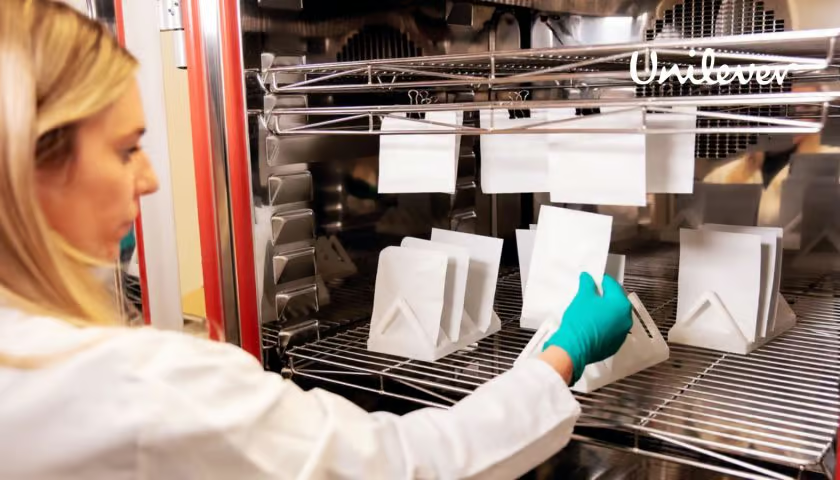
Unilever has more than doubled its investment in packaging R&D in recent years and now has over 60 materials scientists dedicated to next-generation paper-based materials and advanced barrier coatings.
It has evaluated more than 3,000 emerging materials and technologies, including bio-sourced and mineral-based options such as plant-based proteins and ultra-thin, plastic-free coatings derived from naturally abundant compounds like silica, some of which originate in pharmaceuticals and electronics.
Unilever emphasizes that there is no universal solution and that innovations must be tailored by product type, geography, and household storage conditions, while ensuring that paper fibres are sustainably sourced to avoid unintended environmental trade-offs.
The company has already begun moving a range of paper-based flexible technologies toward commercial use, citing the example of recyclable paper-based Knorr stock cube wrappers launched in the UK.
Because stock cubes contain fat, the packaging must prevent grease from soaking through or staining the paper, which could compromise pack integrity and shelf life, requiring not only a material change but a full supply-chain transformation.
Unilever has reconfigured factory equipment so that folded paper wrappers can run smoothly and reliably on production lines, and that these early launches are helping Unilever adapt manufacturing processes, shift its supply chain, and learn how consumers respond to new pack formats.
Meanwhile, the PaperFlex Consortium brings together Unilever with other FMCG giants, including Mars, PepsiCo, Procter & Gamble, Reckitt, and L’Oréal, to jointly fund and conduct R&D on paper-based flexible packaging that can function as a drop-in replacement for conventional plastic films.
The initiative is designed to address key performance gaps such as barrier properties against moisture, oxygen, and grease, as well as runnability on existing filling and sealing equipment, which have so far limited the widespread adoption of paper-based flexibles in categories like snacks, confectionery, home care, and personal care.
Sign up to receive our email newsletters with the latest news updates and insights from Africa and the World HERE.