Lather, Rinse, Digitize: Why Your Next Bar of Soap Was Dreamed Up by a Server

Digital systems today shape how many personal care products are developed and manufactured across the Middle East and Africa. A personal care factory that once relied mainly on chemistry, oils, and fragrances now relies on data. Servers now run beside mixing tanks, and software, helping teams design formulas, manage production lines, and track ingredients across the supply chain. Personal care manufacturers across the region are increasing their use of digital tools in product design and factory operations.
Why Manufacturers Are Investing in Digital Systems
According to Grand View Research, the MEA beauty and personal care product market is projected to hit US$107 million by 2030, growing at an 8.2 percent CAGR. Premium products are expanding even faster, driven largely by Gulf consumers. Manufacturers cite three main reasons for adopting digital production systems:
Speed to market.
Social media can turn a new ingredient into a global trend within weeks. Moroccan argan oil, Ethiopian frankincense, and Egyptian black seed oil, for example, have all gained rapid attention online. Brands that move quickly can capture premium shelf space.
Furthermore, manufacturers now use digital twins. These are virtual models of production lines that allow engineers to test formulas and processes before running them in the factory. According to McKinsey, this approach can reduce development time by 20 to 50 percent and lower quality costs by about 15 to 25 percent.
Killing downtime before it kills you.
Unplanned downtime remains one of the largest cost risks in personal care manufacturing. In Gulf countries, summer heat can push warehouse temperatures above 50°C. In parts of West Africa, humidity and dust can damage electronic components and machinery. Manufacturers now use sensor networks and predictive analytics to detect early signs of equipment failure. Deloitte reports that predictive maintenance can reduce maintenance costs by up to 30 percent and cut downtime by nearly half.
Making waste feel unwelcome.
Traditional filling systems often add a small extra volume to avoid underfilling products. Over millions of units, that margin increases raw material use significantly. Digital filling controls measure each unit precisely and adjust output in real time. McKinsey estimates that digital precision systems can reduce material waste by 15 to 20 percent.
Digital Manufacturing in the Gulf
In the UAE, Precision Group supplies packaging for the likes of Procter & Gamble and Johnson & Johnson from its Jebel Ali fortress. The company adopted Oracle Cloud to replace its older enterprise system. As IT head Jayakumar Mohanachandran put it with refreshing honesty, “Our customers wanted us to disrupt”. So Precision became the first UAE manufacturer to trial Oracle Cloud, replacing a system old enough to vote. Now they have real-time visibility into every corner of their operation, from raw material receipt to finished goods dispatch. The Jebel Ali Free Zone, home to over 800 manufacturers, processes 15 million shipping containers annually through the world’s largest man-made harbor. That’s a lot of bottles heading to a lot of bathrooms across the region.
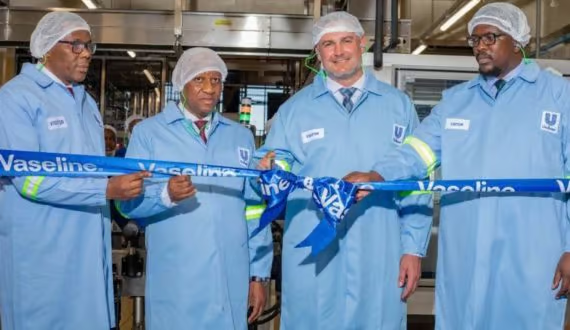
Other manufacturers in the Gulf are making similar investments. In Saudi Arabia, Unilever’s Jeddah factory is flexing with fully automated lines handling blending, cooling, filling, and packaging at peak efficiency. The kingdom, under Vision 2030, is pouring SAR60 million (US$16 million) into automated personal care production. Because if you’re going to diversify beyond oil, soap is a surprisingly good place to start, everyone needs it, and nobody thinks about it until it’s gone.
Khimji Ramdas in Oman, the kind of conglomerate that sells both luxury watches and laundry detergent, implemented SAP to track inventory in real time across its sprawling consumer products division. They cut stockouts by 30 percent while reducing excess inventory holding costs. Not bad for a bit of software that mostly just sits there and counts things.
Across the Gulf, the message is clear: if your factory isn’t smart, it’s going to look pretty dumb.
Digital Systems and Halal Compliance
Halal certification isn’t just about ingredients anymore; it’s about the whole digital shebang. Standards bodies like SMIIC now care about every step of production, from raw material sourcing to cleaning between batches to packaging materials. These requirements favor manufacturers with well documented production systems, but it also demands the kind of rigorous documentation that digital systems provide effortlessly.
Companies like SGS and Cotecna provide verification services, with Cotecna officially blessed by the GCC Accreditation Center and notified by the UAE Ministry of Industry and Advanced Technology. Even West Africa is getting in on the act: eHalal.io has rolled out a digital supply chain management system for OIC countries, including Burkina Faso, Mali, and Niger. Because halal isn’t just a label; it’s a promise, and digital keeps promises better than humans ever could.
The Chinese Wave Across Africa (and Why It Matters)
Chinese manufacturers are quietly dominating African shelves, and the numbers are staggering. According to CITIC Securities, the top five players in African baby diapers hold 61.2 percent market share; in sanitary pads, it’s 39.8 percent. They’ve outmaneuvered global giants like Procter & Gamble through the (integrated industry and trade) model, build factories locally, hire Africans, source where possible, and use digital tools to juggle fourteen different currencies and regulatory regimes.
By manufacturing in-country, they slash delivery times from months-long ocean shipping to under 15 days. They reduce costs enough to offer prices below international brands while keeping gross margins around 30 percent. They adapt products for local conditions, smaller sachet sizes for daily purchasing, formulations that survive humid climates, packaging that travels on bumpy roads.
And since 95 percent of African retail happens through tiny, informal shops that often lack addresses, they use mobile apps and GPS to track inventory in places that don’t exist on Google Maps. These digital tools help companies track inventory and deliveries even in informal retail networks.
Sunda Group, backed by a US$155 million IFC investment, is expanding production of baby diapers and sanitary pads across Kenya, Tanzania, Ghana, and Zambia. Unicharm, the Japanese giant, is targeting US$13 million in sales of its Sofy pads in West Africa by 2026. The market for baby diapers in Kenya alone is projected to hit US$255 million in 2025. That’s a lot of bottoms staying dry, and a lot of opportunity for manufacturers who get digital right.
Unilever’s Twin-Continent Tango
Global multinationals are also increasing digital investment across the region. Unilever provides perhaps the most comprehensive case study spanning both regions. In February 2026, the company announced a landmark five-year partnership with Google Cloud to accelerate AI transformation across its operations. According to Willem Uijen, Unilever’s chief supply chain officer, “Technology has moved to the core of value creation at Unilever”. The company has trained over 23,000 factory colleagues in digital skills globally. Unilever’s Head of Supply Chain in Africa, Christian Byron, affirmed that 70 percent of raw and packaging materials the company uses for production on the continent are made in Africa.
In Nairobi, Unilever commissioned a new US$3.5 million automated warehouse facility with automated storage and retrieval systems. In Ghana, the government allocated GHS 292.4 million (US$27 million) in the 2026 Budget for the Free Sanitary Pad Initiative, with the Vice President specifically praising manufacturers investing in local production.
The Bottom Line
Digital production systems are now becoming standard in personal care manufacturing in the Middle East & Africa. Manufacturers use data systems to test formulations faster, monitor production equipment, manage inventory, and track supply chains. Governments and certification bodies also require detailed documentation that digital platforms provide easily. As the regional personal care market continues to grow, companies that invest in these systems will likely gain stronger control over cost, speed, and product consistency.
Sign up to receive our email newsletters with the latest news updates and insights from Africa and the World HERE.