
Lucart strengthens French tissue operations with new PM15 machine
The group is installing a new tissue machine supplied by Toscotec, advancing both its production-growth ambitions and its decarbonisation strategy.
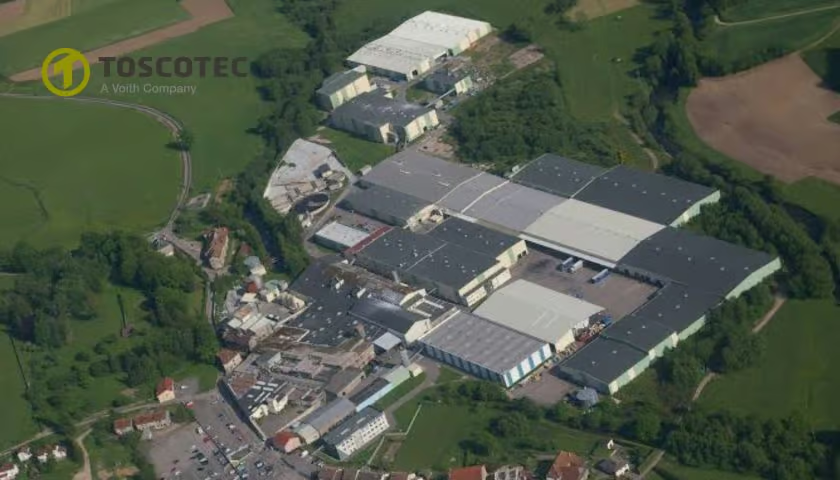
FRANCE – Lucart S.p.A., an Italian paper manufacturing company, is strengthening its long-term manufacturing presence in France with an investment at its Laval-sur-Vologne site in the Vosges region, eighteen years after acquiring the facility in 2008.
The new project forms part of Lucart’s wider plan to increase annual tissue-paper production capacity to 400,000 tonnes by the end of 2027. At the same time, it is intended to reduce the carbon intensity of tissue production by enabling a progressive shift away from fossil-fuel-based thermal processes towards electrified, lower-carbon energy sources.
The new Toscotec PM15 machine will replace existing technology at the Laval-sur-Vologne plant.
According to the company, once commissioned, it will increase the facility’s total tissue-paper production capacity to 75,000 tonnes per year.
The PM15 is based on Toscotec’s AHEAD 1.8 technology and is designed to operate at speeds of up to 1,800 metres per minute.
It will manufacture premium toilet paper and towel grades within a basis-weight range of 15 to 22 grams per square metre.
The line will include a shoe press, a technology that supports higher paper quality while improving the efficiency of the dewatering process.
The most significant feature of the project is its approach to heat generation and use. Drying is typically the most energy-intensive part of tissue-paper manufacturing, and Lucart’s new line has been designed to allow the thermal process to transition gradually to lower-carbon electricity.
The machine’s drying hoods will be fitted with both electric heaters and gas burners, allowing the system to operate with up to 100% electricity as the available energy mix and infrastructure permit.
In addition, the high-efficiency Yankee dryer will receive steam from a new electric boiler.
This configuration is intended to reduce the direct emissions associated with operating the PM15 line and support the site’s broader decarbonisation pathway.
Since its acquisition in 2008, the Laval-sur-Vologne site has developed into one of Lucart’s principal production hubs in Europe.
Over a 15-year period, the French subsidiary tripled its turnover and created more than 100 additional jobs.
The site now employs approximately 350 people.
The facility has also expanded its product offering and adopted circular-material technologies.
In 2011, Laval-sur-Vologne became one of the first sites in Europe to manufacture tissue paper using recycled beverage cartons, contributing to the development of Lucart’s Fiberpack® technology.
Lucart has also increased its logistics capacity in France to support the growth of the site. In 2023, the group announced the acquisition of a logistics centre in Saint-Dié-des-Vosges, which began operations in 2024.
The 22,000-square-metre facility can store approximately 20,000 pallets. It was established to consolidate finished products and coordinate shipments to France, Germany, the Benelux countries and Northern European markets. The logistics centre operates in close coordination with the Laval-sur-Vologne plant, helping connect production with regional distribution.
Laval-sur-Vologne now plays a central role in Lucart’s European industrial network. Its location in the heart of Europe, close to major Central and Northern European markets, enables the group to integrate manufacturing and distribution activities through links with the Saint-Dié-des-Vosges logistics hub and Lucart’s other production operations.
The PM15 project reflects Lucart’s aim to make its next stage of expansion more efficient and environmentally responsible. Rather than focusing only on increased output, the investment combines additional capacity with a production system capable of using a greater proportion of electricity and reducing direct operational emissions.
According to Pasquini, Lucart’s development in France illustrates how industrial investment can evolve alongside changing market requirements and environmental priorities. The new PM15 line represents that evolution by giving the group more production capacity while creating a more efficient and lower-carbon foundation for future growth.
Sign up to receive our email newsletters with the latest news updates and insights from Africa and the World HERE.