
L’Oréal joins Closed Loop Partners to accelerate small-format plastic recovery
With the law set to take effect on January 1, 2027, the state gives the group a real-world setting to refine a roadmap that brands, recyclers, and end markets can use more widely as EPR programs expand.
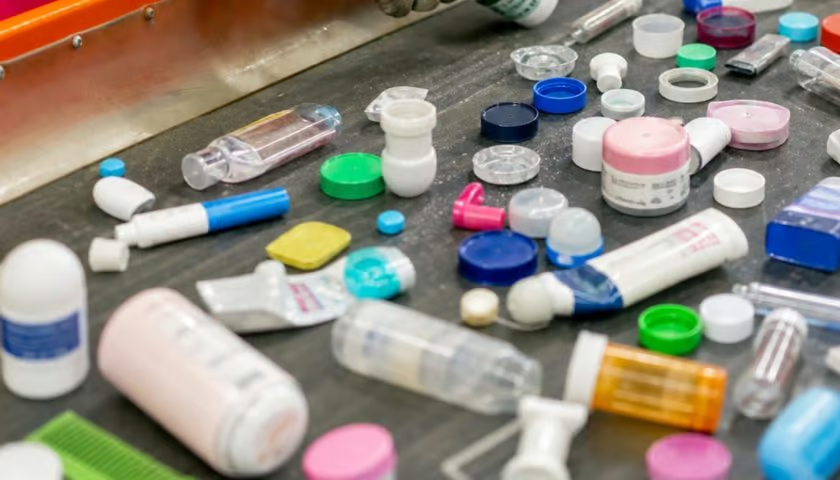
USA – L’Oréal has joined Closed Loop Partners’ Smalls Consortium to help solve the challenge of small-format plastics that too often end up in landfills simply because they are too small for conventional recycling systems to reliably capture.
The initiative brings together L’Oréal, Kraft Heinz, CVS Health, and the Circular Action Alliance to develop a scalable recovery strategy to keep these materials in circulation rather than sending them to waste.
The consortium is carrying out its field testing in California, where SB 54 and the state’s broader extended producer responsibility framework are creating an important test case for packaging recovery.
According to L’Oréal, the project is meant to build the systems needed to recover, sort, process, and create demand for small-format materials.
The company describes this as both an environmental responsibility and a business priority, since improving recovery can lower supply chain risk, improve readiness for EPR requirements, and help secure future material supply.
Using its established methodology, the Smalls Consortium is working to design a recovery solution that can be replicated at scale.
Its approach includes site assessments, material characterization studies, equipment evaluations, financial modeling, recovery trials, and engagement with end markets, all aimed at producing real-world findings from a California facility that can guide broader implementation.
For the field trials, the consortium is partnering with Potential Industries, four regional satellite facilities, and a major materials recovery facility in Southern California.
The work is organized around four main goals: building a practical, data-backed roadmap for CAA and other stakeholders, strengthening recycling infrastructure so small-format packaging can be captured curbside, making sure recovered material can be turned into new products, and improving packaging design with brands and retailers.
Closed Loop Partners is also working closely with CAA, the nonprofit producer responsibility organization chosen by California, Colorado, Maryland, Minnesota, Oregon, and Washington to help develop EPR program plans for paper and packaging under each state’s law.
This collaboration places the Smalls Consortium within a broader policy effort to prepare companies for a new packaging-recovery landscape.
Sign up to receive our email newsletters with the latest news updates and insights from Africa and the World HERE.

