Unilever reports strong H1 FY25 results with 4.8% sales growth
This performance pushed quarterly growth to 5.8%, the company’s best volume quarter in more than a decade.
UK – Unilever has posted strong first-half 2026 results, with underlying sales growth of 4.8% and a sharper second-quarter acceleration.
The performance was volume-led, with 4.2 % points of H1 growth coming from volume and 0.6 percentage points from price, while Power Brands continued to outperform, and every business group delivered volume-led growth.
Chief executive Fernando Fernandez said, “We have delivered a strong volume-led performance in the first half, with a significant step-up in the second quarter – the best volume quarter at Unilever in over a decade.”
“Our Power Brands continued to outperform, with all Business Groups delivering volume-led growth.”
He added, “Emerging markets showed momentum, India, Indonesia and Latin America all delivered strong growth, while North America again outperformed its market.”
Following the stronger-than-expected first half, the company now expects 2026 underlying sales growth to fall within its long-term 4% to 6% range, with around 3% underlying volume growth, second-half growth of 4% to 5% led by pricing, and a modest improvement in full-year underlying operating margin versus 20.0% in 2025.
The first-half review showed that Power Brands grew underlying sales by 6.0% and volume by 5.4%, underscoring their role as the main growth engine.
Unilever said all business groups posted volume-led gains in the half, with Beauty & Wellbeing, Personal Care and Home Care all accelerating further in the second quarter, while price growth softened in Q2 because of temporary factors including strong comparators in Personal Care, FIFA World Cup 2026 promotional activity and the carryover effect of 2025 Home Care actions in Brazil.
Beauty & Wellbeing delivered 5.9% underlying sales growth, supported by 4.5% volume growth and 1.3% price growth.
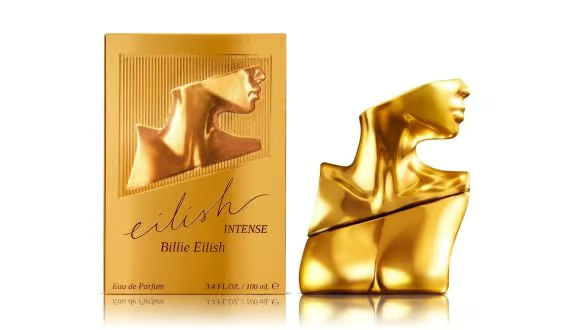
The division was led by double-digit gains from Dove, Sunsilk and Vaseline, alongside strong momentum in prestige beauty, while the Wellbeing business grew at a low-single-digit pace and improved in the second quarter.
Personal Care rose 4.8%, with 4.1% volume growth and 0.7% price growth.
Skin cleansing and deodorants both delivered mid-single-digit growth, helped by Dove’s premium innovations and Unilever’s FIFA World Cup 2026-related campaigns and activations in the second quarter.
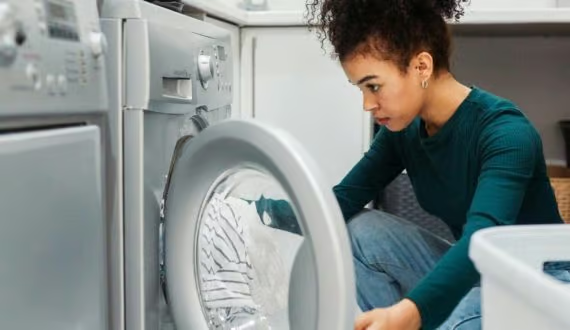
Home Care was the standout business, growing 7.6% overall with 7.4% volume growth and 0.2% price growth.
Growth was broad-based and strongest in India and Brazil, while emerging markets delivered double-digit growth in the second quarter and developed markets posted low-single-digit gains in the first half.
Meanwhile, Food sales grew just 1.2%, entirely volume-led, as developed markets were pressured by softer demand and stronger competition in the US condiments market.
Unilever said it is taking steps to recover share in premium and avocado mayonnaise in the US, while Unilever Food Solutions recorded low-single-digit growth and continued to build momentum in its key markets.
By geography, developed markets, which account for 40% of group turnover, grew underlying sales by 1.5%, with North America leading the region and Europe remaining subdued.
North America rose 2.7% in H1 and accelerated to 3.6% in the second quarter, supported by strong performance in Personal Care and prestige beauty, while Europe fell 0.9% due to softer markets and weaker food pricing.
Emerging markets, representing 60% of turnover, grew 7.0% in the half and accelerated to 8.3% in the second quarter.
India was a standout, growing 8% in H1 and 10% in Q2, with market share gains across Home Care and Beauty & Wellbeing, while China, Indonesia and Latin America also contributed to the growth momentum.
Financially, Unilever’s turnover increased to €25.6 billion (USD 29.18 billion), up 0.5% year on year, with acquisitions adding 0.7% and currency reducing growth by 4.9%.
Underlying operating profit rose 0.9% to €5.2 billion (USD 5.93 billion), underlying operating margin improved by 10 basis points to 20.3%, and operating profit increased 2.6% to €4.9 billion (USD 5.58 billion).
Gross margin came in at 46.8%, down 70 basis points, as volume leverage and productivity gains were partly offset by commodity inflation, calibrated pricing and planned FIFA World Cup 2026 promotions.
Brand and marketing investment remained broadly stable at 16.1% of turnover; overheads improved by 70 basis points, driven by productivity gains and cost discipline; and the company said gross margin in the second half should be broadly similar in absolute terms as price growth accelerates.
Capital allocation remains unchanged, with Unilever prioritising investment in growth and productivity while continuing bolt-on acquisitions, selective disposals, dividend payments and share buybacks.
The second-quarter dividend was set at €0.4664 (USD 0.531), up 3% from the prior-year period, and the company said its €1.5 billion (USD 1.71 billion) share buyback programme was completed in June 2026.
During the half, Unilever also carried out several portfolio actions, including the sale of its Home Care businesses in Colombia and Ecuador, the sale of Graze, the disposal of its Indonesia Tea business, the sale of its stake in Kwality Wall’s (India) Limited and its Portuguese ice cream joint venture, as well as the acquisition of Grüns, a fast-growing US greens supplement company.
Sign up to receive our email newsletters with the latest news updates and insights from Africa and the World HERE.