Middle East beauty market to hit USD 20.8B by 2030, report finds
The growth is driven by strong GCC demand, premiumization, and the region’s emergence as a global innovation hub.
UAE – According to BeautyMatter’s 2026 report, GCC In Focus, Middle East Beauty Market Past Present Future, the Middle East beauty market is forecast to grow from USD 14.3 billion in 2025 to USD 20.8 billion by 2030.
The report places the Middle Eastern beauty market on a rapid expansion path, with a compound growth trajectory that outpaces many mature markets. While the global beauty market grew by around 6% in 2025, the Middle East and Africa region expanded by 16%, making it one of the fastest-growing beauty regions worldwide.
The six Gulf Cooperation Council (GCC) countries, Bahrain, Kuwait, Oman, Qatar, Saudi Arabia, and the UAE, are treated in the report as a single economic bloc valued at approximately USD 2.3 trillion, comparable in size to the economies of France or Italy.
Saudi Arabia dominates regional beauty spending, accounting for roughly 40% of total GCC beauty expenditure.
The Kingdom’s fragrance market alone was valued at USD 2.9 billion in 2025, and per-capita beauty spending in Saudi Arabia stands at USD 164.9, higher than most Western European markets.
Beyond Saudi Arabia, the UAE, Kuwait, Qatar, and Bahrain are collectively pushing innovation in retail formats and brand positioning, helping to diversify the region’s beauty landscape.
Population growth in the GCC is expected to rise steadily at about 2% year-over-year, with the UN projecting the region’s population to reach 83.6 million by 2050, underpinning long-term demand.
The report attributes much of the region’s beauty growth to a young, digitally connected demographic: over half of the GCC population is under 30.
Rapid urbanization and rising disposable incomes are fueling demand for modern retail formats and higher-value consumer products.
BeautyMatter describes the Arab beauty consumer as “one of the most sophisticated in the world”, highly knowledgeable, digitally engaged, and discerning, willing to invest in premium products only if they deliver genuine performance.
This sophistication is expected to drive premium beauty to outpace mass beauty across all GCC markets through 2030.
The GCC is increasingly shifting from being viewed primarily as a strategic consumption market to an “innovation hub” that actively shapes global beauty trends.
Homegrown brands such as Huda Beauty, Kayali, Amouage, and Lattafa now operate internationally, signalling the region’s growing influence beyond its borders.
The report frames the next chapter of GCC beauty as defined by “scale, specificity, and resilience,” supported by demographic momentum, concentrated wealth, and an increasingly mature founder, investor, and regulatory ecosystem.
Multinational beauty groups are significantly expanding their Gulf footprints in response to this growth. L’Oréal plans to double its Saudi workforce by the end of 2026, and its Middle East division was among the group’s top five global growth contributors in 2025. Manuel Villaveces, general manager of Professional Products at L’Oréal Middle East, stated, “Saudi Arabia is not just a market we serve. It is one we are actively co-building with.”
“The future of beauty in Saudi Arabia over the next five years will be defined by hyperpersonalization, seamless connectivity, and purposeful, tech-driven experiences. Saudi Arabia is rapidly transforming from a consumer market into a leading incubator and testing ground for global beauty innovation.”
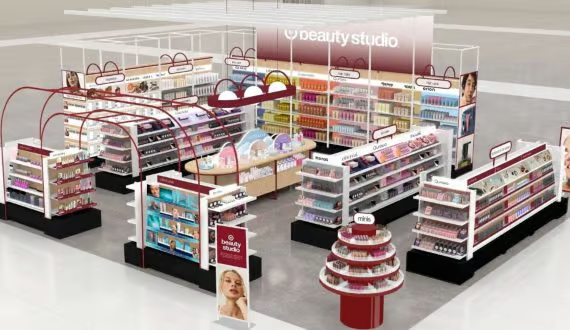
Ulta Beauty has also entered the region via franchise partner Alshaya Group, opening first in Kuwait in November 2025, followed by locations at the Mall of the Emirates (January 2026) and Dubai Mall (March 2026), with a Saudi opening planned later in 2026.
Fragrance emerges as a particularly lucrative growth driver in the Middle East beauty market. Xavier Renard, global head of Fine Fragrances at Givaudan, notes that Arab consumers prioritize how a fragrance smells over brand or packaging, and that layering multiple scents is common practice.
He highlights that while Saudi Arabia’s population is around 35 million, its fragrance consumption is roughly four times that of Europe or the US, effectively making it equivalent to a 140-million-person market in fragrance terms.
The report also points to an impending “skin care revolution” in the Middle East, with Gen Z at the forefront. Dina Sidani, founder of Dubai-based personalized prescription skincare brand Ilik, describes younger consumers as curious, experimental, and hungry for knowledge.
Despite strong growth, the report cautions against treating the Middle East as a monolith.
The region is home to more than 40 distinct ethnic and ethnoreligious groups, and international brands that once used a one-size-fits-all approach now face demands for greater cultural relevance and reliability.
Within the GCC, Saudi Arabia and the UAE together account for about 77% of the bloc’s GDP, but nuanced differences in consumer behaviour, regulation, and retail infrastructure persist across markets.
Growth is expected to continue despite macroeconomic and geopolitical challenges.
In early 2026, rising US–Iran tensions contributed to raw material shortages and supply chain disruptions, prompting major chemical suppliers such as BASF, Ashland, Wacker Chemie, Dow, Lanxess, and Nouryon to adjust pricing across their portfolios.
Some personal care companies responded with targeted mitigation strategies, including increased financial support to suppliers and diversified sourcing. Even so, industry leaders emphasize the region’s strategic importance.
Sign up to receive our email newsletters with the latest news updates and insights from Africa and the World HERE.