Unilever invests USD 538,710 in 800kW solar plant in Nairobi
Unilever’s decision mirrors a broader migration among Kenyan manufacturers and commercial enterprises toward captive power generation.
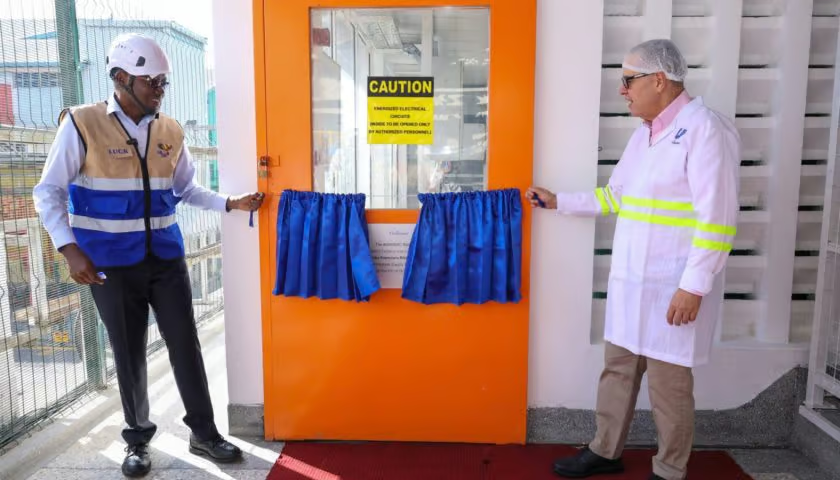
KENYA – Unilever has committed KES 70 million (USD 538,710) to install an 800kW solar power system at its Nairobi manufacturing plant, joining a growing wave of Kenyan producers adopting renewable energy to tame soaring electricity bills.
The new solar array is projected to meet roughly 30% of the factory’s power demand and cut the company’s annual energy expenditure by about KES 30 million (USD 230,000), as industries across Kenya prioritise operational resilience amid costly and volatile grid power.
The move comes as local manufacturers grapple with some of the steepest industrial electricity tariffs in East Africa, pushing many to generate their own electricity and wean themselves off the national grid.
In parallel, Unilever has reduced its fossil fuel footprint by converting its boilers from heavy fuel oil (HFO) to biomass, a shift that, together with the solar project, has cut the Nairobi plant’s carbon emissions by around 40% relative to its 2023 baseline.
João Ribeiro, Unilever’s 1UL supply chain head, said such investments enhance operational resilience and competitiveness while lowering dependence on conventional energy, adding that the Nairobi factory is a critical node in the company’s manufacturing network and that the project illustrates how site-level action supports broader climate goals.
For manufacturers wrestling with rising production costs, the financial impact is material: energy represents a large share of factory operating expenses, and Unilever’s Nairobi site currently pays about KES 12 million (USD 92,350) per month for electricity.
With the solar system in place, the company expects its monthly power bill to fall to between KES 7 million (USD 53,871) and KES 8 million, a reduction of more than 30%, while it continues to spend roughly KES 8 million a month on heavy fuel oil for thermal needs. Elodie Kouassi, head of supply chain for East Africa (excluding Ethiopia), described the investment as proof that sustainability and strong business performance can advance hand in hand.
Companies are increasingly installing solar systems to shield themselves from high grid tariffs, insulate production from outages and make energy costs more predictable.
Firms such as Bamburi Cement, Mabati Rolling, Unilever Tea Kenya, Bidco Africa, British American Tobacco and Carbacid Investments have already integrated solar solutions into their operations.
Luck Ochieng, managing director of Unilever East Africa, said that by scaling up renewable energy use, the company is cutting operational emissions, containing energy costs and fortifying its supply chain, benefits that can ultimately be passed on to consumers in the form of more affordable products.
However, the rapid expansion of captive generation is creating a strategic challenge for Kenya Power, as large commercial and industrial customers reduce their purchases from the national utility.
Sign up to receive our email newsletters with the latest news updates and insights from Africa and the World HERE.