Johnson & Johnson offers USD 5.5B to resolve outstanding talc lawsuits
The deal would only move forward if lead plaintiff firms representing about 95% of the remaining claims participate.
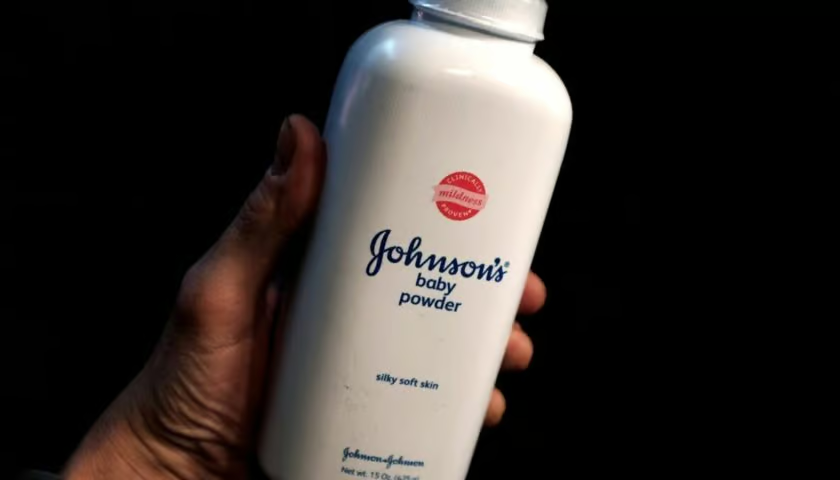
USA – Johnson & Johnson has proposed a USD 5.5 billion settlement to resolve roughly 76,000 remaining lawsuits alleging that its talc-based baby powder caused ovarian cancer.
The proposal follows a favourable ruling for J&J. On July 22, 2026, a federal judge ordered plaintiffs to explain why their claims should not be dismissed for failing to show how J&J’s talc products specifically caused each claimant’s ovarian cancer, after plaintiffs withdrew their own specific-causation experts.
In a statement, Erik Haas, J&J’s worldwide vice president of litigation, said, “After decades of litigation and full vetting of the science in an extensive hearing, plaintiffs effectively conceded their inability to prove specific causation by withdrawing their experts on the topic in two bellwether cases.”
“In a watershed moment, the court thereafter ordered plaintiffs to show why the remaining claims should not be dismissed, confirming what we have maintained for years: that these claims lack scientific merit and were sustained only by unreliable expert opinions that could not survive rigorous judicial review.”
If approved, J&J would make an initial payment of no more than USD 3 billion in 2027, with further payments delayed until 2028.
The company described the proposal as an efficient way to conclude the litigation, building on earlier progress in resolving about 95% of mesothelioma lawsuits, all state consumer protection claims, and all talc-supplier disputes.
The talc litigation has dragged on for years, with thousands of plaintiffs alleging cancer links to J&J’s talc products.
Mesothelioma claims generally centre on asbestos-contaminated talc exposure, while ovarian cancer suits argue that repeated use of talc in the genital area may allow particles, including possible asbestos fibres, to travel through the reproductive tract and contribute to inflammation or cancer development.
The asbestos-mesothelioma connection is well established, but the claim that talc causes ovarian cancer remains disputed.
Regulatory views have also differed, with some authorities classifying talc more cautiously than others despite reviewing similar evidence.
FDA-commissioned testing in 2019 reportedly found asbestos in nine of 52 talc-containing cosmetic products, including one sample from a J&J baby powder lot, prompting a recall. J&J said its own testing found no asbestos.
The company stopped selling talc-based baby powder in the US and Canada in 2020, later announced a global phase-out in 2022, and completed that phase-out in 2023.
Throughout, J&J has maintained that its products are safe and has described contrary claims as “junk science.”
Sign up to receive our email newsletters with the latest news updates and insights from Africa and the World HERE.